

A network that governs itself. Onchain. By math.
The Network Nervous System (NNS) is a fully autonomous, onchain governance organization built directly into the Internet Computer protocol — and the largest, busiest network governance ever deployed.
Fully autonomous network administration and orchestration.
The NNS acts as the brain of the Internet Computer network. Different kinds of proposals can be submitted, many of which the network executes completely automatically once they are adopted. Proposals exist to create new subnets and scale out the platform’s capacity, and even to update the version of the replica software run by node machines — something that traditional blockchains must do through slow, messy “hard fork” processes that create security risks.
The NNS implements liquid democracy: voting neurons created by staking ICP can be configured to vote automatically by following other neurons, allowing the network to cascade to decisions. The design makes it overwhelmingly difficult for an attacker to push through a malicious proposal.
Its capabilities are still expanding — the NNS now plans to act as the registrar and DNS server for a truly decentralized TLD domain. The network’s chain-key system grants the NNS its own 48-byte public key, against which it can sign, and this anchors verification of all compute across the entire network.
Four properties that make autonomous governance work.
Community-driven
Anyone can submit a proposal. Liquid democracy ensures the wishes of those staking ICP tokens are observed.
Security & stability
Rigorous voting algorithms prevent ambush attacks and ensure the actions taken are consistent with the network's interests.
Rapid evolution
The Internet Computer can adapt and upgrade autonomously, providing for unusually rapid technical evolution.
Transparency
Proposals are processed onchain — the logic and data are tamperproof, the results transparent and unequivocal.
How participation works.
To take part in network governance, users create “voting neurons” and grant them voting power by locking ICP tokens inside. Neurons gain maturity when they vote — maturity that can later be used to generate new ICP tokens.
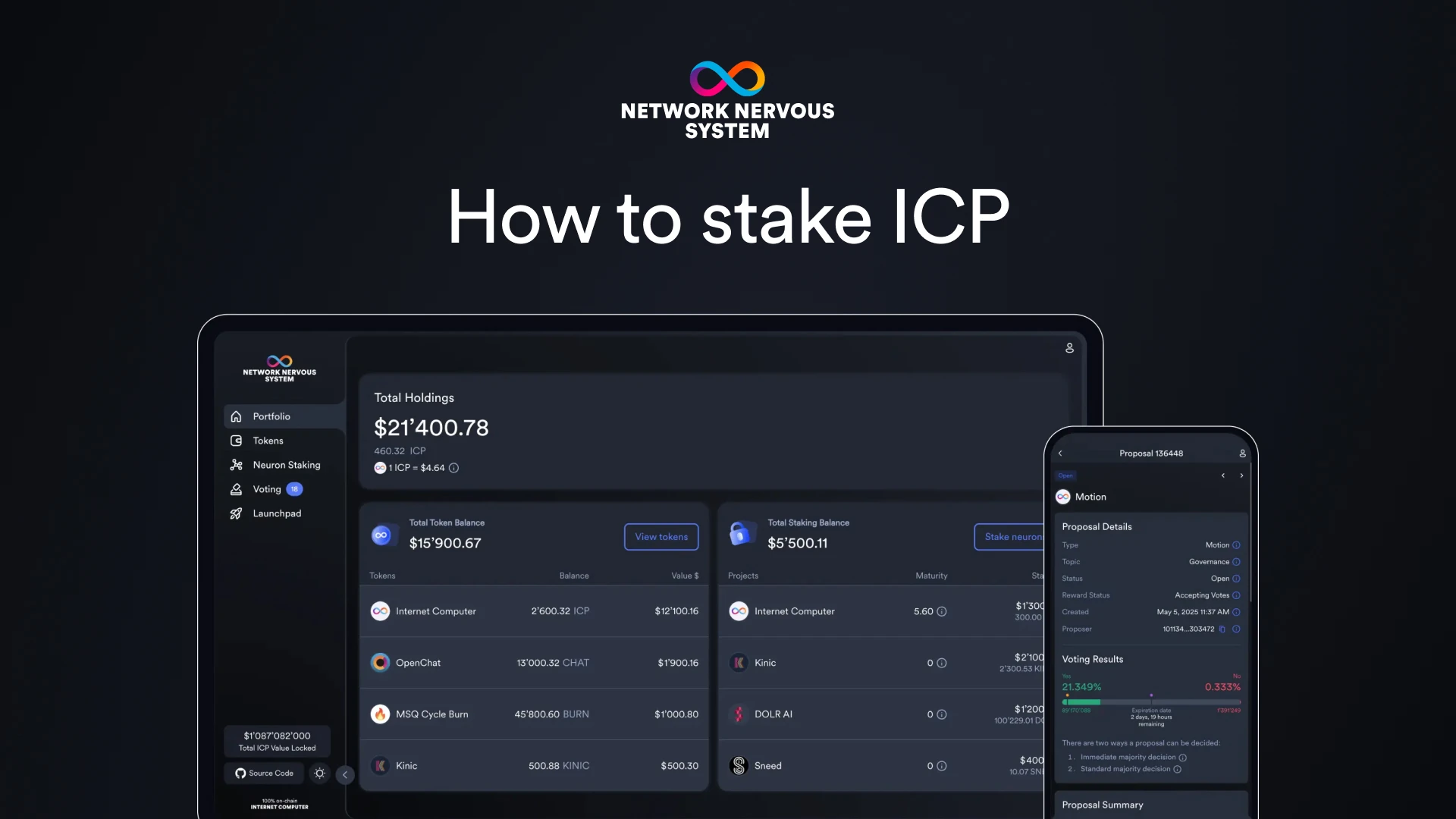
- Create one or more voting neurons inside the NNS, then lock ICP tokens inside.
- Configure each neuron to vote automatically on specific proposal types by following other neurons.
- When neurons vote — manually or automatically — their maturity increases.
- Use accumulated maturity to generate new ICP tokens.
DAO control for online apps.
The NNS governs the network itself. Apps that need to decentralize their own control use a sibling system called the SNS — assign an app to one and an “open internet service” emerges, with its own tokenomics and full community control.

By assigning an application to an SNS, control of that application is handed over to a fully decentralized digital governance system — no backdoors, no single operator, no foundation. Token-holders of the SNS direct the app the way ICP-holders direct the network.
More about SNS DAOsRead the rest of the section.
Internet cloud economics
ICP, cycles, reverse gas, and the closed-loop model that keeps the platform self-sustaining.
Read economicsNetwork statistics
Blocks processed, transactions per second, cycles burned — the metrics that tell you how the network is performing right now.
See the statsNetwork history
A timeline from early research in 2015 through the launch in 2021 to the self-writing cloud era.
Read the historyNNS Explained
A YouTube playlist walking through the Network Nervous System and SNS DAO governance from first principles.
Watch the series